- Family owned since 2011
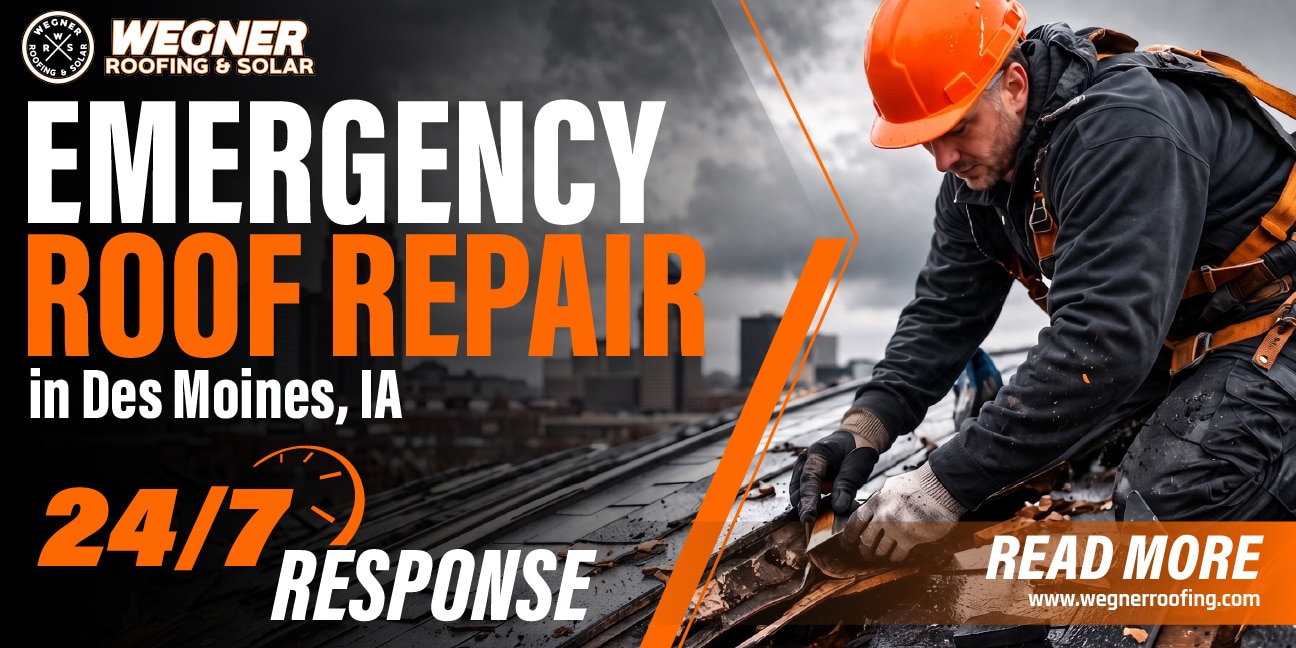
Emergency Roof Repair in Des Moines, IA – 24/7 Response
2,000+
Five-Star Reviews
5,000+
Projects Completed
15 Years
In Business
24/7
Emergency Response

Ceiling Leaking? Secure Your Home Fast
When a severe Midwest storm hits, waking up to a leaking ceiling is every homeowner’s worst nightmare. If you desperately need emergency roof repair in Des Moines IA right this second, stop reading and dial our 24/7 dispatch line immediately. Wegner Roofing & Solar always answers live, any time of day or night. We rapidly deploy a specialized Central Iowa crew directly to your property to halt water intrusion before it permanently destroys your attic insulation, drywall, and interior framing.
For those who have a moment to research before their situation worsens, this guide provides the exact answers you need. We break down what genuinely qualifies as an urgent roofing crisis in our local climate, our precise arrival timeline, expected costs, and crucial steps to shield your living space in the frantic minutes before our team arrives.
Stop watching the water spread and start taking control of the damage. Deploy Wegner Roofing & Solar’s rapid response unit to your driveway right now to lock down the leak, protect your interior, and get a permanent solution in motion.
What Actually Qualifies as a Roofing Emergency?
Not every roof problem needs a 2 a.m. phone call, but when severe weather strikes, knowing exactly when to request emergency storm roof repairs can save you both money and stress.
True emergencies (call immediately, day or night):
- Active water dripping or pooling inside your home
- A tree limb, branch, or storm debris has punctured the roof deck
- Large sections of shingles are missing after a wind event
- A ceiling is visibly bulging or sagging from trapped water
- Storm damage has occurred during or immediately after a severe weather warning
- Exposed decking is visible from the ground after high winds
Urgent, but not middle-of-the-night (call within 24 hours):
- A small, contained stain that isn’t growing or spreading
- A single missing shingle with no visible interior moisture
- Minor flashing wear noticed during a routine seasonal check
- A gutter pulling away from the fascia without active leaking
The distinction matters because a roof deck can absorb water for hours before a stain even appears on your ceiling, meaning that by the time you see the drip, insulation and decking may already be saturated underneath. Every hour of delay on an active leak roughly compounds the drywall and insulation replacement cost, based on how quickly saturated cellulose insulation loses its R-value and begins sagging under its own weight.
Once insulation compresses from moisture, it typically doesn’t regain its original loft even after drying, which means a same-night call versus a next-morning call can be the difference between a patch job and a full ceiling replacement.
Our 24/7 Emergency Response Timeline
Here’s the actual sequence once you call (515) 985-5454, step by step:
- Live phone answer (0 to 2 minutes). A real person in our Central Iowa office takes your call directly, not an automated answering service reading from a generic script.
- Triage questions (2 to 5 minutes). We ask where the water is entering, whether it’s active or slowing, whether any structural sagging is visible, and how old your roof is, so the crew arrives already prepared with the right tarping materials and fasteners for your specific roof pitch.
- Dispatch (typically same day, often within hours). A local crew based near West Des Moines is routed to your address across the Des Moines metro, prioritizing active-water calls ahead of scheduled estimates.
- Emergency tarping (30 to 60 minutes on-site). We seal the compromised area with commercial-grade tarping, secured with furring strips rather than just adhesive tape, to withstand ongoing Iowa wind while you wait for the permanent fix.
- Documentation. Every call for emergency roofing services in Des Moines includes timestamped photos of the exterior and interior damage, evidence that becomes critical if this turns into an insurance claim later.
- Permanent repair scheduling. Once the bleeding stops, we schedule the comprehensive roof leak repair, usually within a few days depending on material availability, roof-deck drying time, and weather conditions. Our team provides reliable roof repair in Des Moines to address the source of the leak and restore your roof’s protection.
Because our crews are based locally rather than dispatched from a regional call center, we’re not adding a multi-hour drive time on top of your wait, a real, measurable difference from national roofing chains that subcontract to whichever crew happens to be available that week.
What to Do in the First 30 Minutes While You Wait
Do:
- Move furniture, electronics, and valuables away from the drip zone immediately
- Place a bucket or large container to catch water and protect flooring underneath
- If the ceiling is bulging with trapped water, carefully puncture it in one controlled spot with a screwdriver so it drains into a bucket rather than collapsing unpredictably across a wider area
- Take photos of the interior damage as it’s happening, timestamped if possible, for your own records
- Shut off electricity to any light fixture or outlet near the leak as a safety precaution
Don’t:
- Climb onto a wet, storm-damaged, or steep roof yourself, roofing-related injuries spike immediately after storm events specifically because homeowners attempt DIY inspections on compromised, slippery surfaces
- Use a household tarp and duct tape as a permanent fix, standard hardware-store tape fails within days under sustained wind load and temperature swings
- Wait until morning if water is actively entering, every additional hour increases the chance of mold colonization, which typically begins within 24 to 48 hours of sustained moisture exposure in warm, humid conditions
- Ignore a small ceiling stain just because it isn’t dripping yet, a stain often means the deck above is already saturated and simply hasn’t reached full capacity

For a full nighttime-specific walkthrough including what to do if the leak starts at 3 a.m. and no crew can reach your home for several hours, see our detailed guide on what to do when your roof leaks at night.
Emergency Tarping vs. Permanent Repair: What's the Difference?
|
Factor |
Emergency Tarping |
Permanent Repair |
|
Purpose |
Stop active water intrusion immediately |
Restore the roof to full function |
|
Materials |
Reinforced poly tarp, screws, furring strips |
Matching shingles, flashing, underlayment |
|
Timeline |
Same day, often within hours |
1 to 3 days depending on scope and weather |
|
Cost |
Often minimal or bundled into repair estimate |
Based on damage extent, pitch, and access |
|
Insurance role |
Insurers expect prompt mitigation of further damage |
Becomes the documented scope for your claim |
|
Expected lifespan of the fix |
Days to roughly two weeks in Iowa wind, not a season |
Years, backed by a written workmanship warranty |
The mistake we see most often in Des Moines: homeowners treat a tarp as a solution instead of a stopgap. A standard poly tarp under sustained 20-plus mph Iowa spring winds typically loosens at the fasteners within 10 to 14 days, which is exactly why we schedule the permanent fix while the tarp is still holding rather than waiting for a callback.
Seasonal Emergency Triggers Specific to Des Moines
Winter Ice Dams (December to March)
The first measurable snowfall in Des Moines typically arrives in November, with the last snowfall usually recorded in April, and February historically brings the heaviest snowfall of the season. Snowfall averages around 26 inches each year in the metro, a pattern validated by historical climate data from the National Weather Service Des Moines.
When daytime melt refreezes overnight at your eaves, it forms a dam that forces water back up under your shingles, this is the single most common emergency call we take between January and early March, particularly in Urbandale, Johnston, and the mature tree-canopy neighborhoods around Drake University, where uneven shading slows melt-off on parts of the roof while the sunnier side clears faster, creating an imbalance that worsens ice buildup at the eaves.
Spring and Summer Derecho/Wind Events (April to August)
Central Iowa sits in a corridor prone to straight-line wind events. A single derecho-force gust, the kind the region saw in the historic August 2020 Midwest Derecho documented by the NOAA can strip large sections of shingles in seconds, exposing decking to rain within the same storm cell that caused the damage. If your emergency traces back to a specific dated storm, that becomes an insurance matter, see our full storm and hail damage roof repair process for how claims and documentation actually work.
Summer Thunderstorm Debris (June to August). Mature trees around Waukee, Clive, and Grimes neighborhoods mean falling limbs are a recurring cause of deck punctures after fast-moving summer storm cells roll through the metro, often with little warning between a clear sky and a severe thunderstorm watch.
Local Case Example: A West Des Moines Night Call
A homeowner near Jordan Creek Town Center called at 11:40 p.m. after a wind gust lifted a section of ridge shingles during a passing thunderstorm, and water began dripping through a bedroom ceiling light fixture within the hour. Our on-call team walked her through shutting off the circuit to that fixture for safety, dispatched a crew by 8 a.m., and had the section tarped before 9:30 a.m., well before the next wave of storms rolled through that afternoon.
The permanent shingle repair was completed two days later, once the roof dried out enough for the adhesive seal strips to bond properly. That drying window matters more than most homeowners realize: shingle sealant strips generally need dry, above-40°F conditions to re-adhere correctly, which is why rushing a permanent fix onto a still-soaked deck often fails within a single season and requires a costly repeat visit.
Where We Provide Emergency Roof Repair
As a trusted provider of roofing in Des Moines, we understand that rapid response times are critical when severe weather strikes. Wegner’s emergency crews cover the full Des Moines metro and Polk County, including Des Moines, West Des Moines, Ankeny, Urbandale, Johnston, Waukee, Clive, Grimes, and Altoona.
Our central base is strategically located at 1301 50th St in West Des Moines, which keeps our drive times incredibly short. Whether your distress call comes from near Jordan Creek, the historic Drake neighborhood, out toward Adventureland in Altoona, or the rapidly growing subdivisions along the Ankeny–Bondurant corridor, our local teams are positioned to reach you fast and stop the damage.
Cost and Insurance: What to Expect
Emergency tarping to stop active water intrusion is typically a minimal, same-visit cost, often folded into the permanent repair estimate rather than billed separately as a standalone charge.
If your emergency traces to a covered storm event, your insurer generally expects prompt mitigation, meaning the tarping step, followed by a documented repair estimate that becomes the basis of your claim; this is exactly what our storm damage claims process handles from first tarp to final settlement.
For emergencies unrelated to a specific storm date, an aging flashing failure or a worn vent boot, for instance repair cost depends on the extent of damage, roof pitch, and materials involved, and we always provide a firm written estimate before any permanent work begins, so you’re never guessing on price mid-repair.
Why Homeowners Call Wegner First
When searching for reliable roof repair in Des Moines, residents look for a company with a proven track record and experience handling roof insurance coverage for hail damage. We’ve served Central Iowa since 2011, not as a storm-season pop-up that disappears once the insurance check clears, but as a dedicated, year-round local crew with GAF and Owens Corning factory certifications backing our workmanship.
You don’t just have to take our word for it. Our commitment to doing things right the first time is reflected directly on our Des Moines Google Business Profile, where the community shares their real experiences.
As local homeowner Lisa Lynes recently shared:
“Quality work and great communication throughout the process. I would highly recommend Wegner Roofing and Micah Meyers for any project and will use them again.”
You can review our full company credentials, comprehensive warranty terms, and complete exterior service lineup on our homepage.
Frequently Asked Questions
How fast can Wegner respond to an emergency roof leak in Des Moines?
Most emergency roofing services calls are answered live within minutes, with a crew dispatched the same day. Response speed depends on storm volume and your location within the metro, but tarping is typically completed within hours of your call.
Is emergency tarping included in the cost of my repair?
Often yes. Emergency tarping is typically bundled into your written repair estimate rather than billed as a separate line item, though final pricing depends on the scope and materials needed for your specific situation.
Can a roof leak cause a ceiling collapse?
Yes, if water pools long enough. A sagging or bulging ceiling means water has already saturated the drywall and insulation above it, and the safest step is a controlled release with a small puncture into a bucket rather than waiting for it to fail on its own unpredictably.
Should I call my insurance company or a roofer first during an emergency?
Call the roofer first if water is actively entering your home; stopping the damage takes priority over paperwork. Once the leak is controlled, we can help document everything your insurer will need if you end up needing to file a hail damage insurance claim or report other storm-related damage.
Do you charge extra for nighttime or weekend emergency calls?
Emergency response is available 24/7 without a separate off-hours surcharge tacked onto your estimate; you’ll see the full cost breakdown in your written quote before any work begins, day or night.
What's the difference between calling for "roof repair" versus a true "roof emergency"?
A roof emergency means water is actively entering your home or structural damage is visible right now. Standard repair covers everything else, worn flashing, aging shingles, or minor leaks that can safely wait for a scheduled visit; see our full roof repair page for that broader scope.
Will emergency tarping void my roof's manufacturer warranty?
No. Emergency tarping is a temporary mitigation step, not a permanent alteration, and it doesn’t affect your GAF or Owens Corning manufacturer material warranty as long as the permanent repair is completed by a certified crew afterward.
Staring at a storm-damaged roof or an active ceiling leak tonight? Take immediate control of the situation before it compromises your home’s interior. Request an emergency dispatch from Wegner Roofing & Solar’s 24/7 Des Moines crew right now at (515) 985-5454 and let us stop the damage tonight.
Get Your Free Estimate