
- Family owned since 2011
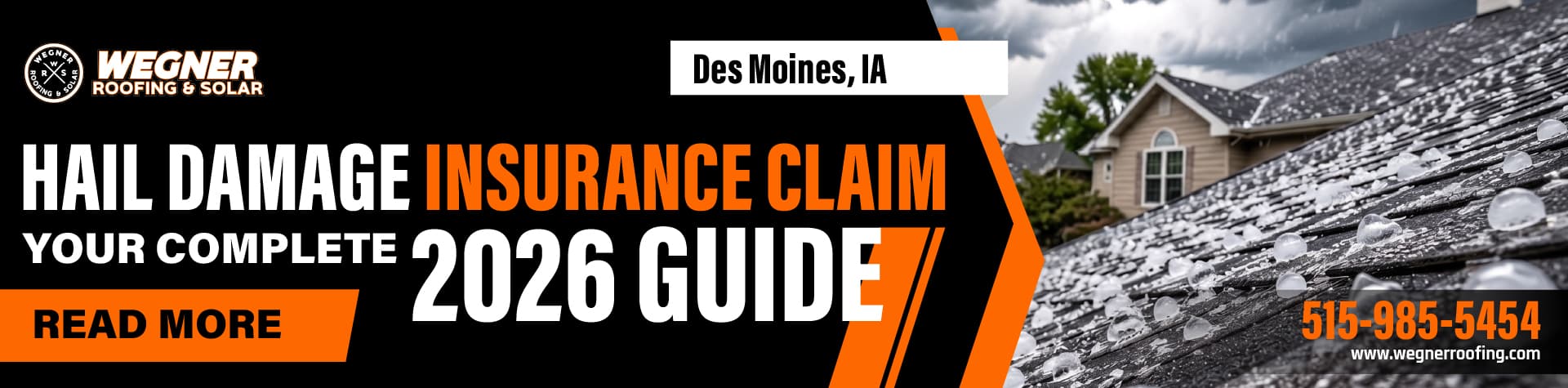
Hail Damage Insurance Claim: Your Complete 2026 Guide
2,000+
Five-Star Reviews
5,000+
Projects Completed
15 Years
In Business
24/7
Emergency Response
Surviving the Storm: Your 2026 Roadmap to Winning Your Roof Claim
A violent hailstorm tearing through Des Moines can end in just ten minutes. However, the grueling process of filing a successful hail damage insurance claim often drags on for weeks. If you make the wrong moves during the critical first 72 hours, it can cost you thousands of dollars. Many homeowners fail to spot hidden roof impacts, which eventually leads to denied payouts when severe leaks appear months later.
This guide provides your immediate answer to taking back control. We deliver the exact, step-by-step roadmap required to navigate your policy, properly document the destruction, and secure the total funds you deserve. You will find no filler here, only the critical information needed to protect your home. Wegner Roofing & Solar, a nationally ranked top contractor, consistently guides Iowa neighbors through this exact process with total transparency.
Do not face the adjusters alone. Reserve your professional storm damage evaluation with our 24/7 emergency response team today by dialing 877-GOT-ROOF.
What Hail Does to Your Roof Before You Even Notice
Most homeowners step outside after a storm, look up, see no obvious destruction, and assume their property is fine. This can be an incredibly expensive mistake. You do not need an immediate water leak to have severe, valid roof damage. Hail impacts can fracture the underlying shingle matting and loosen protective granules, creating small vulnerabilities that gradually worsen over time. By the time water finally reaches your ceiling months or years later, your insurance filing window may have already closed.
Understanding Hail Damage Roof Repair Costs Des Moines Insurance Coverage begins with a timely and properly documented inspection. Professional roof damage claim assistance can identify hidden damage, estimate the necessary repairs, and provide evidence you may need when discussing your claim with your insurance provider.
As detailed in our guide on how to spot hail damage roof Iowa insurance claim tips, high-velocity hail leaves a distinct forensic signature on asphalt shingles.
To identify true storm damage, look for the following signs:
- Random, Circular Craters: Hail impacts appear as dark, circular bruises scattered unpredictably across the shingle surface, completely unlike regular wear and tear that follows standard drainage or foot traffic paths.
- Exposed Asphalt Mat: The force of the impact strips away the outer ceramic granules, leaving the bare, black asphalt layer vulnerable to sun and rain.
- Metal Dents and Dings: Check soft metal components like roof vents, flashing, gutters, and downspouts. Craters or splatter marks on these elements confirm that the hail hit with enough force to cause structural compromise.
If your shingles show these unmistakable signs of granule loss or cracking, your roof requires immediate attention before you move forward with your insurance claim.
Understanding Your Policy Before You File a Hail Damage Insurance Claim
Before you pick up the phone to call your insurer, spend 20 minutes with your policy. Two terms control everything about your payout.
ACV vs. RCV — The Difference That Can Cost You Thousands
Here’s what that means in practice: With ACV, a new roof that costs $15,000, but your 20-year-old roof has depreciated by 80%, means your payout would be just $3,000 for a covered claim, minus your deductible. With RCV, that same roof is covered at full replacement cost.
Wind and Hail Deductibles in Des Moines, IA: What to Expect
Your standard homeowners deductible and your specific wind/hail deductible may be two very different numbers. For homeowners in Des Moines, IA, wind and hail deductibles typically run between 1% and 2% of your home’s total insured value.
That means if your property is insured for $300,000, your out-of-pocket expense before the insurance company pays anything could range from $3,000 to $6,000. It is critical to know your exact deductible amount before you start the process. If your total hail damage roof repair costs fall below this threshold, filing a claim will not put money in your pocket, but it could still result in a premium increase.
Filing Deadlines: Time is Ticking for Des Moines Homeowners
Every state in Wegner’s service area enforces strict claim windows, and Iowa is no exception. You must file your claim promptly after a severe weather event occurs.
For residents in Des Moines, IA, standard policies strictly require you to file your hail damage claim within 12 months of the storm date. Keep in mind that every week of delay gives insurance carriers more room to argue that your roof’s damage is due to pre-existing wear and tear or neglect, rather than the recent storm. Protect your property and file fast.
The Hail Damage Insurance Claim Step by Step Process

Step 1: Get a Contractor Inspection Before Your Adjuster Arrives
This is the single most important thing you can do. Filing a hail damage roof insurance claim starts with documenting the damage through photos and reviewing your policy to understand coverage.
Wegner Roofing & Solar provides pre-adjuster inspections across all five states. Our team documents every impact point with photographs formatted specifically to adjuster standards, giving you a professional scope of work before the insurance company’s representative sets foot on your property.
Step 2: Document the Damage (Photos & NOAA Reports)
Immediately after the storm, take date-stamped photos and videos of the damage from multiple angles. Be sure to place a common object, like a coin or tape measure, next to the impact marks to show the hail’s exact size.
Beyond photos, pull the official NOAA storm report for your zip code. A verified record detailing the storm date, grid location, and hail size provides undeniable proof that an insurance adjuster cannot dispute.
Don’t delay your hail inspection. In Des Moines, homeowners who wait often lose their ability to prove the damage was storm-related. Insurance carriers actively use satellite and weather data to challenge late claims, which could leave you paying for the entire roof replacement out of pocket.
Step 3: File Your Claim and Record Your Claim Number
Start the claims process by calling your insurance provider to report the severe weather event and the exact date it occurred. The carrier will then dispatch an adjuster to inspect your property and evaluate the damage.
During this initial call, it is crucial that you write down your official claim number and the name of the adjuster assigned to your case. Your representative will then walk you through the remainder of the process and inform you if any additional documentation is required.
Step 4: The Adjuster Visit: Have Your Contractor Present
Set a time for you, your spouse, a reputable contractor specializing in roofing in Des Moines, and the insurance adjuster to meet. After large storms, insurance companies often send adjusters from out of state. Meeting in person helps your contractor explain issues like the effects of hail on your home. This is harder to do later by phone after the adjuster has returned to their home office.
Wegner’s team attends adjuster visits as standard practice. We point out every impact point our inspection documented, cross-reference the scope against your policy, and make sure no line item is missed. When entire regions are affected by the same hailstorm, assessments and estimates can be rushed or superficial. Our on-site presence ensures yours is not.
Step 5: Review the Statement of Loss Before You Sign
If the insurance adjuster’s estimate seems low, you have the right to negotiate. Many homeowners make the mistake of accepting the first estimate provided by the insurance adjuster, even if it seems too low. Insurance adjusters may try to minimize the payout. It’s important to get a second opinion from a trusted roofing contractor and negotiate if necessary.
Review the Statement of Loss line by line. Confirm that the scope covers: complete tear-off, new underlayment, replacement of all soft metals (gutters, drip edge, flashing), and labor at current 2026 rates. Labor rates in Polk County have risen 9% year-over-year as demand spikes after every major storm system, an outdated rate schedule in your settlement costs you real money.
Step 6 : The Two-Check RCV Payment Process Explained
If you have an RCV policy, your payout arrives in two installments, and many homeowners don’t know to expect the second check. Here’s the actual payment timeline: First check, ACV portion: after claim approval, the carrier sends you the replacement cost minus held-back depreciation. This is your working capital to begin the project. Second check, depreciation release: after your licensed contractor completes the work and submits proof of completion, the carrier releases the held-back depreciation amount.
Do not cash the first check and walk away thinking you’ve been paid in full. The second check, the released depreciation can represent thousands of dollars. Wegner submits your completion documentation directly to the carrier to ensure that a second payment is triggered promptly.
Step 7: Dispute a Low Settlement (Appraisal Clause)
If the insurer’s final offer doesn’t match the true cost of your loss, you are not powerless. Request a formal re-inspection or hire a public adjuster for an independent assessment. You can also invoke your policy’s appraisal clause for a third-party umpire. Always use a contractor’s detailed, written scope of work as your strongest evidence to dispute denials.
How Wegner Roofing & Solar Handles Your Hail Damage Insurance Claim
Since 2011, Wegner Roofing & Solar has provided permanent, local roofing services. We are not fly-by-night storm chasers. When severe weather strikes, you need a dependable roofing contractor in Des Moines, IA to help navigate hail damage insurance claims in Des Moines. We understand how local weather affects your property.
Free Pre-Adjuster Inspections & Adjuster Advocacy
We accurately document every detail before your insurance adjuster arrives. Our comprehensive property assessments cover everything from shingle damage to dented soft metals, vents, and gutters. We provide expert insurance claims assistance, advocating on your behalf to ensure the carrier accounts for all necessary repairs or replacements. We handle the complex documentation and negotiations so you can focus on recovering from the storm.
Proven Expertise & Unmatched Warranties
Our industry accreditations speak for themselves. We proudly hold GAF Certified, Owens Corning Preferred, and IKO Craftsman Premier designations. These elite manufacturer partnerships allow us to back our roof replacements with industry-leading lifetime material warranties. Furthermore, we protect your investment with our own 5-year labor and materials workmanship guarantee. Unlike seasonal contractors, we maintain local, fully staffed offices to honor our commitments long after the storm clears.
Don’t face a complex hail damage insurance claim alone. Contact Wegner Roofing & Solar today to get your storm damage assessment and professional adjuster representation.
Frequently Asked Questions
Does homeowners insurance cover hail damage to my roof?
Yes, in most cases. Standard homeowners insurance covers hail damage in most states. However, coverage details vary based on your insurer, your policy type (ACV vs. RCV), and whether you have cosmetic exclusions. Review your declarations page before filing.
How much do hail damage roof repairs cost in 2026?
On average, fixing a hail-damaged roof runs about $4,250. However, depending on the severity of the storm, roof repair bills can range anywhere from $375 for minor fixes up to $7,500 for more extensive work. If a large home requires a complete roof replacement, costs can easily surpass $14,000. Your final out-of-pocket expense will ultimately depend on your specific insurance deductible and the type of coverage you carry.
What is the difference between ACV and RCV on my hail claim?
ACV factors depreciation into your claim, while RCV does not. Because RCV claim payouts are usually higher, this type of coverage usually costs more and may not be available for older roofs. With ACV, a 15-year-old roof may yield a fraction of replacement cost. With RCV, you receive full replacement value minus only your deductible.
How long do I have to file a hail damage insurance claim?
Most policies require you to file within 1 year of the damage, but some states allow up to 2 years. However, filing within 30 to 60 days is ideal. The sooner you file, the easier it is to document storm-related damage versus normal wear.
Will a hail damage claim cause my insurance rates to go up?
For the most part, no. Since you cannot control the weather, hail damage is generally classified as a “no-fault” claim by insurance carriers. Submitting a single, valid claim for storm damage rarely causes a significant spike in your premium. The primary exception to this rule is if you have a history of filing numerous claims within a short timeframe, which can prompt your provider to increase your rates.
What if my insurance adjuster's estimate seems too low?
You have three options: request a formal re-inspection with a different adjuster, invoke the appraisal clause in your policy for binding third-party review, or hire a public adjuster. Reach out to a trusted local roofing specialist to come to your home at the same time as the adjuster to ensure your assessment is carried out fairly. Wegner attends all adjuster visits for our clients at no additional cost.
Get Your Free Estimate