Table of Contents
Des Moines homeowners get roughly 199 sunny days a year, and winters are cold enough to spike heating bills, making the solar panel payback period one of the first questions asked before signing a contract.
The honest answer for a typical Polk County home in 2026 falls between 9 and 14 years, depending on system size, roof orientation, and how MidAmerican Energy credits your exported power. That range matters because it is the difference between a system that pays for itself well before its 25-year warranty expires and one that barely breaks even.
For a standard two-story home in Des Moines, a 6- to 9-kilowatt solar array provides substantial power coverage. The initial investment often feels intimidating at first glance, but the yearly energy offset delivers lasting value.
Wegner Roofing & Solar has installed enough systems across central Iowa to know that the real payback question is not the sticker price, but how fast saved and credited electricity adds up.
What Changes a Solar Panel Payback Period in Des Moines, IA
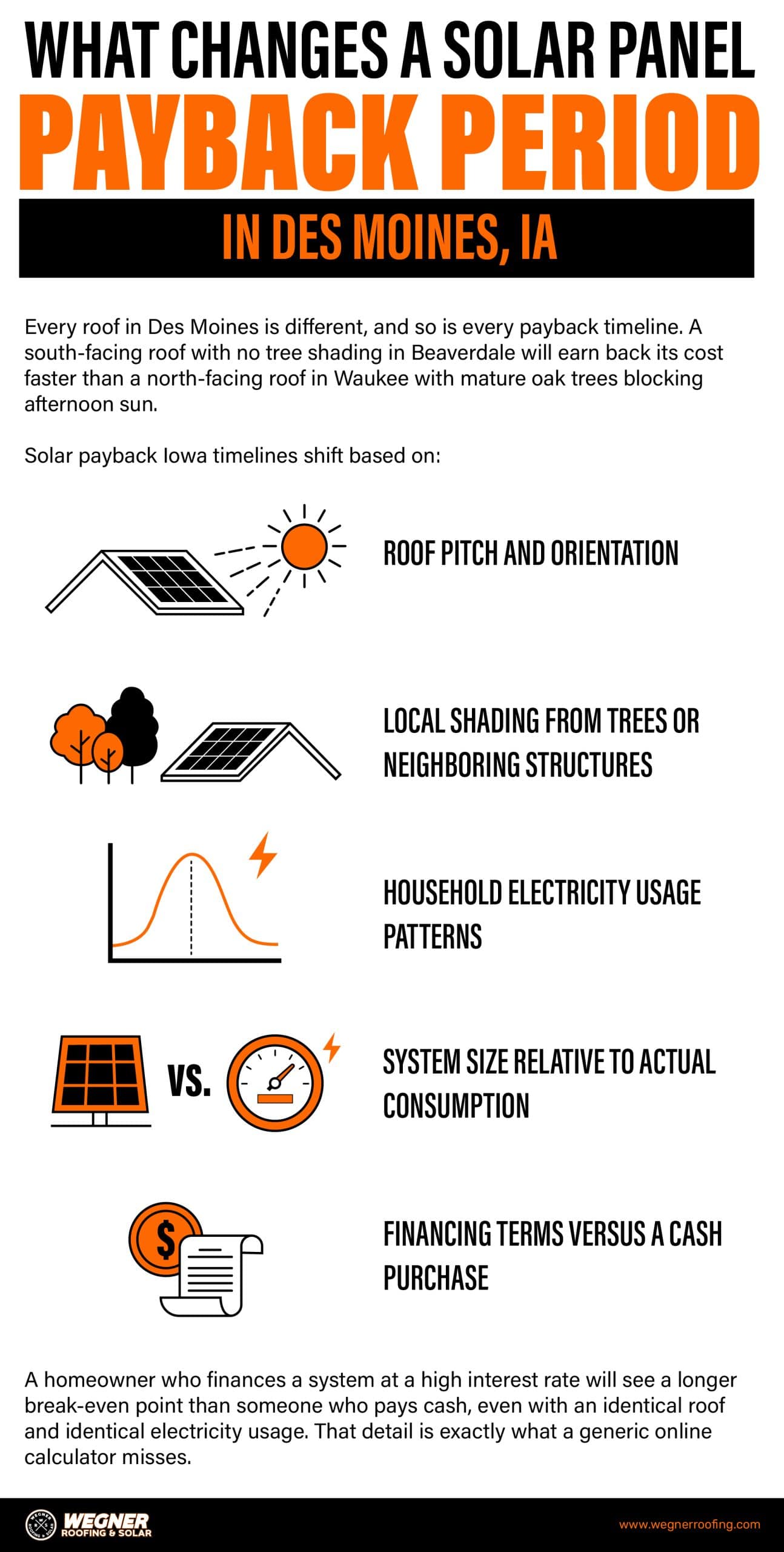
Every roof in Des Moines is different, and so is every payback timeline. A south-facing roof with no tree shading in Beaverdale will earn back its cost faster than a north-facing roof in Waukee with mature oak trees blocking afternoon sun.
Solar payback Iowa timelines shift based on:
- Roof pitch and orientation
- Local shading from trees or neighboring structures
- Household electricity usage patterns
- System size relative to actual consumption
- Financing terms versus a cash purchase
A homeowner who finances a system at a high interest rate will see a longer break-even point than someone who pays cash, even with an identical roof and identical electricity usage. That detail is exactly what a generic online calculator misses.
Want a real number instead of a guess? If you’d like a payback estimate built around your actual roof and energy bills, Wegner Roofing & Solar can run the numbers on-site.
Contact our Des Moines solar team to see where your home realistically lands.
How MidAmerican Net Metering Rules Affect Your Break-Even Point
- Inflow-Outflow Billing: Under Senate File 583, MidAmerican customers receive actual dollar credits on their bill for excess energy sent to the grid, rather than traditional rolling kilowatt-hour credits.
- 20-Year Retail Rate Lock: Every exported kilowatt-hour is credited at the full retail rate for 20 years from the date the system is interconnected.
- Financial Viability: This guaranteed retail rate lock makes solar economically workable in Des Moines by offsetting Iowa’s lower-than-average electricity rates.
- Looming Expiration Date: The current rate lock expires once statewide rooftop solar penetration reaches 5% or by July 1, 2027, whichever comes first. After that, new systems will shift to a different “value-of-solar” rate structure.
- 2026 Urgency: Homeowners weighing a solar purchase are encouraged to lock in the current credit now, as the upcoming shift will directly lengthen the payback period for future installations.
Solar ROI Des Moines Homeowners Should Expect After the Federal Credit Change
The Federal Residential Clean Energy Credit, which used to cover 30 percent of a system’s cost, expired for homeowner-owned systems at the end of 2025. That single change is the biggest reason payback periods in 2026 run longer than they did just two years ago.
Without that credit, homeowners cover a larger share of the upfront cost themselves, stretching the solar ROI in Des Moines timeline by roughly two to four years compared to 2023 or 2024 installations.
Two state-level breaks are still in place and worth factoring into your math:
- A 6 percent Iowa sales tax exemption on solar equipment purchases
- A 5-year property tax exemption on the added home value from the system
These do not replace the lost federal credit, but they meaningfully soften the impact on your overall solar panel payback period.
Solar ROI Des Moines Homeowners Should Expect After the Federal Credit Change
The Federal Residential Clean Energy Credit, which used to cover 30 percent of a system’s cost, expired for homeowner-owned systems at the end of 2025. That single change is the biggest reason payback periods in 2026 run longer than they did just two years ago.
Without that credit, homeowners cover a larger share of the upfront cost themselves, stretching the solar ROI in Des Moines timeline by roughly two to four years compared to 2023 or 2024 installations.
Two state-level breaks are still in place and worth factoring into your math:
- A 6 percent Iowa sales tax exemption on solar equipment purchases
- A 5-year property tax exemption on the added home value from the system
These do not replace the lost federal credit, but they meaningfully soften the impact on your overall solar panel payback period.
Why Electricity Rate Iowa Solar Math Works Differently Than in Other States
Iowa’s below-average electricity rates are usually framed as bad news for solar shoppers, and there is some truth to that.
Lower electricity rate in Iowa solar math means each kilowatt-hour you offset is worth less than it would be in a high-cost state like California.
But the 20-year full retail-rate export credit through MidAmerican partially offsets that disadvantage, which is why Des Moines payback periods stay competitive with national averages even though per-kilowatt-hour savings are smaller.
See your specific numbers before you commit. Every roof and utility bill produces a different payback timeline.
Wegner Roofing & Solar will walk you through your inflow-outflow projections in person, so you know exactly what to expect instead of relying on a generic estimate.
Visit our Google Business Profile to see local reviews from homeowners who already made the switch.
You can also see a full breakdown of local costs and incentives in the 2026 Des Moines, IA Home Solar Guide, including how a properly sized solar panel system is selected for your roof.
Key Takeaways
The typical solar break-even years range for Des Moines homes in 2026 sit between 9 and 14 years, depending on roof condition and financing.
MidAmerican’s 20-year full retail-rate export credit locks in per system at interconnection, but the statewide rate structure is set to change after 5 percent penetration or in July 2027.
The expired federal tax credit is the single largest factor lengthening 2026 payback periods compared to prior years.
Iowa’s sales tax and property tax exemptions still reduce total cost, even without the federal credit.
Getting a Payback Number Built for Your Des Moines Roof
A national average will never tell you how fast your specific roof, orientation, and electricity habits will pay off a solar investment.
The only way to know your real solar panel payback period is to have someone measure your roof, review 12 months of usage, and run the current MidAmerican credit structure against it.
For a closer look at real dollar savings, our Solar Panel Savings in Des Moines, IA page breaks down typical monthly offsets for local homeowners.
Wegner Roofing & Solar has been doing exactly that for central Iowa homeowners since 2011, handling the permitting and interconnection paperwork so the process stays straightforward from estimate to activation.
Ready to see your actual numbers instead of a guess?

FAQs About Solar Panel Payback Period in Des Moines, IA
How long until solar panels pay for themselves in Iowa?
In 2026, Des Moines homeowners installing solar face a 9 to 14-year payback period. South-facing, unshaded roofs with high energy offset see the fastest returns. Financed or heavily shaded systems take longer, making site-specific estimates more accurate than national averages.
Does net metering still apply in Iowa?
MidAmerican Energy customers earn full retail credits on exported solar for 20 years under inflow-outflow billing. This shifts to a value-of-solar rate by July 1, 2027, or at 5% solar penetration. Installing beforehand locks in the 20-year retail credit structure.
What changes a solar panel payback period?
Solar payback periods shift based on roof orientation, shading, system size, financing, and MidAmerican’s inflow-outflow billing. Cash purchases repay faster than financed setups. Missing state and federal tax credits also significantly extend 2026 payback timelines compared to earlier solar installations.
Table of Contents
Solar Panel Payback Period in Des Moines, IA Table of Contents Des Moines homeowners get roughly 199 sunny days a year, and winters are cold
Metal Roof vs Asphalt Shingles on an Eastern Iowa Home: Cost Over 30 Years Table of Contents If you’re comparing metal roof cost vs shingles
The Des Moines Roof Replacement Process, Step by Step, and Why the Fall Calendar Fills Table of Contents Once the maples along Grand Avenue start
Black Streaks on Your Des Moines Roof: Algae, Moss, or Something Worse? Table of Contents Drive through Beaverdale or Waterbury after a humid July stretch,
A Tree Fell on Your Des Moines Roof: Inspection and Insurance Steps First Table of Contents Des Moines sits inside a wind corridor that turns